
Like many people we view with a mixture of incredulity and despair how yet again the dead hand of Whitehall is booting West Yorkshire’s Mass Transit Plans in the long grass of the 2030s, 40s and beyond. with grand promises and nothing realised – if ever – for decades beyond glittering headlines and empty promises. But we also feel much of the West Yorkshire Mass Transit Plan is deeply flawed , mired in endless, hugely expensive bureaucracy and in some ways is badly thought through. Only by having segregated light and conventional rail systems both within cities and between towns and cities wile the current nightmare of traffic congestion – which has grown massively since Covid – be relieved.
One huge failure is the inability to make a start on something physical, actual engineering in the ground which once started takes on a reality. Endless surveys, consultations, divisions of opinion get nowhere. We also think much of the concept is ill thought through, driven by politics not pragmatism. Whilst there is an overwhelming need to have some kind of segregated urban transit system for Leeds, the case in other towns in West Yorkshire is less strong but connectivity between towns is another matter. Why for example is a Leeds-Bradford street tram getting priority along a corridor which is already served by fast electric railway via Shipley, a hopefully eventually electrified railway and one fast (X6) and one slow (72) bus services. Probably the best served transport corridor in the Region. If the (eventual) tram is street running it will be little faster than an X6 bus and slower than existing trains but at massive expensive
There is an urgent need however to connect the two stations in Bradford but what is being suggested in terms of a single new station is likely to prove horrendously expensive and disruptive and for that reasons likely to be delayed into infinity, whilst Northern Powerhouse Rail between Bradford and Huddersfield – hardly a hugely busy corridor – is science fiction given the astronomic costs of putting new rail line across densely populated and challenging Pennine hills. We believe more pragmatic, but also technologically advanced approach is needed, and the way forward is to look at some cases still existing old railway formations especially using what should be cutting edge light rail technology. Yet the part of Yorkshire where traffic congestion is at its worst and public transport its most dismal is the central of West Yorkshire that used to known as the Heavy Woollen District where bus service stagnate in horrendous traffic congestion and even the simplest journey takes hours.
Equally appalling is the Leeds -Headingley-Otley corridor where the journey between the busy commuter town of Otley and Leeds now takes up to an hour and a quarter in the peak for just 11 miles – in the 21st century! Much quicker in the 1930s. This in turn is massively increasing traffic congestion as people prefer sitting in traffic jams in their cars than in slow, unreliable buses. We are also aware that the nearby Wharfedale Line ( Leeds/Bradford-Ilkley) has a significantly under-used line/spur into Bradford whose off-peak service has not been restored since Covid and overall passenger use has declined as a result – a downward spiral.
A report by JMP consultants in 2004 suggested that even using heavy rail, the former line between Menston and Otley could be restored at not impossible cost which might offer an interesting possibility if at least off-peak Bradford-Ilkley conventional trains service were to operate not by conventional electric trains, but by modern, lightweight tram-trains providing through or connecting service to Leeds and Bradford. If such vehicles could, using the latest technology, use both conventional electric power from overhead catenary, but run say between Menston and Otley and also across Bradford City Centre on battery, this would save significant costs and visual impact. From Bradford Forster Square the tram train could cross the pedestrianised city centre, street running as in Sheffield to easily link the two existing stations and any possible new station which may or may not be realised. This indeed is also we understand part of the current WYMT proposal.
If the same vehicles could then from the present interchange use the Calder Valley Line (which ought to a top priority for electrification) as far as Low Moor, the tram train could use the old Spen Valley line (preserving the greenway cycle route alongside, with space for this in the old twin track formation), serving reopened or relocated stations including park and ride facilities at Cleckheaton, Liversedge, and Heckmondwike, before splitting to serve Dewsbury or Ravensthorpe. This would create a remarkable range of new local travel choices, far greater than the suggested proposed high speed line, at a fraction of the cost with direct service from the Spen Valley stations into Bradford and with a single change onto a fast train to either Leeds or Huddersfield city and town centre or indeed Manchester on the revitalised TransPennine Express electrics or maybe via Ravensthorpe even to Wakefield.
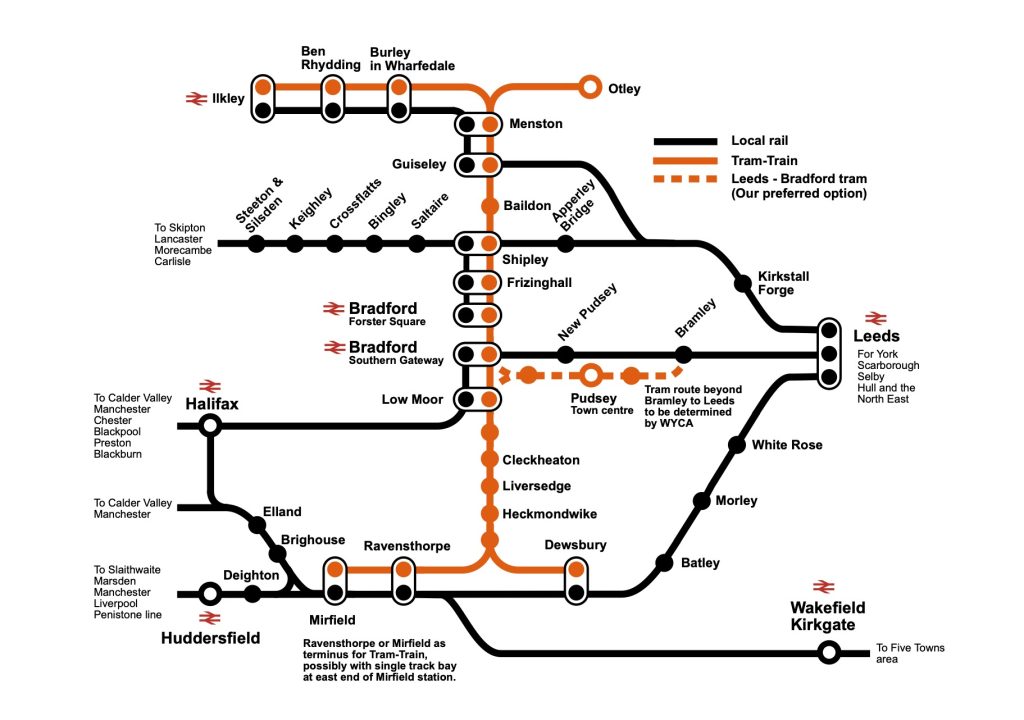
As on any a light rail network you would not necessarily have many tram-trains running between Otley and Dewsbury, but a whole combination of different services to meet actual demand. A further huge benefit of this scheme is that it could be developed incrementally. The restored Menston-Otley spur of the Wharfedale line might even offer, before reopening, a huge opportunity to build a test track free of other rail or road traffic to develop technologically advanced hybrid electric/battery train units capable for use not only in West Yorkshire by other parts of the UK on both rural and urban lines.
This could potentially offer a huge opportunity to work with an academic institution such as Huddersfield University’s Institute of Rail Research to work with one or more major engineering companies to create a new UK rail manufacturing centre within West or South Yorkshire, a British made light rail vehicle capable of being used not only on the Otley branch (which is in the Mass Transit Plan for reopening albeit for maybe the 2070s), but also on the Wharfedale Valley line, running without catenary through Bradford streets and then onto the Calderdale line and finally the Spen Valley. And elsewhere on lightly used or reopened lines elsewhere in Yorkshire and the UK.
Things may seem dire in the UK in terms of railway manufacturing but maybe one of the great European mainland engineering firms such as Stadler or Alstom or even Bombardier could be interested in setting up a UK subsidiary. If this project could be presented in terms of technological investment in UK manufacturing rather than the “cost” of urban transport, we could surely get the backing of key Yorkshire politicians. Creating a test track to reopen the Otley branch might then make sense (in the short term there is even a bay at Guisley station where light rail vehicles could be parked).
We believe that even an initial proposal could get on the political agenda with excellent coverage in Yorkshire Post, Yorkshire Bylines and elsewhere, pending more details appraisals and cost benefit analysis.