Transport Committee call for evidence
A response on behalf of Action for Yorkshire Transport
What are the key features that make a transport system feel joined up to the user? How would ‘integrated’ transport look different to current services and networks?
Users need:
- Timetables (bus, train and tram) printed, online and at bus stops, regularly updated, which provide clear and understandable and promoted modal interchange opportunity both between individual bus services and intermodal.
- Zone-wide Fare Systems which are intermodal and are at a level which offer a realistic and attractive competitive price, compared with using the private car and other modes – e.g. taxis – to both encourage people out of their cars but also ensure those on low incomes, especially young people and job seekers who are now prevented from travelling by excessive and unaffordable cost. This is happening, even with the welcome £3 maxim fare (which can still represent a £12 daily travel charge if more than one bus service is used in each direction). M-tickets in West Yorkshire partly fill this need but are not cross boundary and in most cases are not intermodal.
- Leisure tickets The Day Ranger, the prime West Yorkshire rail-based leisure ticket, cannot be used in weekday peak afternoon, the very time users want to return home, even during school holidays, which massively reduces its use and value. The reason for this is “lack of capacity” on trains which is a woeful and perhaps uniquely British admission of failure of transport policy and a chronic lack of investment over many decades. We use fiscal means to restrict use of trains overcrowded by decisions not to provide sufficient capacity. Unbelievable we also then tacitly encourage the use of private cars with low petrol prices and a freezing of fuel duty. This a lamentable national and regional policy failure, political cowardice in face of the car lobby.
- Rover and ranger travel tickets should include cross boundary services as people living close to Unitary Authority boundaries are excessively penalised, especially as some boundaries e.g. North Yorkshire (between Leeds and Harrogate or Skipton) are purely political and do not follow any natural geographic or economic boundaries. A Netherlands-style Yorkshire Region-wide travel ticket to offer travel within the Region by trains services and then onward travel by local bus in the town or city of arrival would hugely boost usage and convenience and thereby reduce traffic congestion and pollution, a huge economic as well as environmental benefit.
What stops effective integration happening now, and how can these barriers be overcome?
Integration of public transport in the UK took a huge backwards step in 1985 with the notorious Ridley Transport Act that privatised buses and brought in on-street hugely wasteful and disruptive competition on key profitable bus routes, plus the selling off of huge assets – the greatest asset stripping charter of modern times when valuable bus depots and even bus stations were sold off to predatory developers. Minor bus routes and rural networks were then vulnerable to this cherry picking and have declined ever since.
For a time even co-operation between companies was abolished. Unbelievably in South Yorkshire two bus companies sharing common ticketing on each other’s services actually had their offices raided. Passenger Transport Executives in conurbations were later abolished and absorbed into weaker Combined Authorities where they have been predictably marginalised, losing much if not all their hands-on involvement with the managing and marketing of local bus and train routes. .
As a result, we now have the worst of all possible worlds, with large bus companies in our Region offered virtual monopolies and the Combined Authorities lacking financial resources and legal powers, so unable to act even as bus service along prime corridors deteriorate to unacceptably poor levels. This means that, in much of Yorkshire, including West Yorkshire and the Yorkshire Dales, services have been reduced in quality and frequency to an alarming degree. Local authorities have also failed to restrain car use on radial roads into centres such as Leeds or Bradford, leading to huge delays in service and cost increases for bus operators, worsening reliability and timetables, some of which are deliberately extended to allegedly to increase reliability, which they do not. In some cases buses now wait up to 5 minutes along routes to meet even imaginary congestion delays yet still get caught up in later congestion, We now have the worst, perhaps slowest, least reliable bus services in parts of Yorkshire since World War I. This in turn is encouraging ever increasing car and taxi use leading to a “death spiral” which even bus franchising in two or three years’ time is unlikely to reverse, especially as passengers lost, once they have invested in cars, bikes, and even scooters and are unlikely to return without really effective city centre traffic management measures and parking controls and massive new budgets to enhance what are now skeletal services.
What kinds of interventions and policy decisions are needed to provide joined-up transport, including in areas beyond transport such as planning?
Critical is the willingness of local authorities to bring (as in Nottingham) effective city and town centre congestion charge and workplace parking levies whilst offering really attractive bus and tram service, supported by cheaper weekly, monthly and annual multimodal travel tickets. A far greater range of these – even extending as far as Skipton and Harrogate – were available prior to 1986 in West Yorkshire but were weakened or removed over subsequent decades. Such facilities should be cross boundary to reflect economic, social and geographic realities not often arbitrary political boundaries.
Planning and development control decisions should put public transit at the centre of all decisions, whether ensuring access to current well served corridors especially if served by or connected to rail or tram, or working with transport authorities to show that real investment is in place, if appropriate costed into the development, not just pious platitudes quietly ignored by developers as “unaffordable” as soon as planning permission is secured.
How should transport integration and its benefits be measured and evaluated—including the impact on economic growth, decarbonisation and the Government’s other ‘missions’?
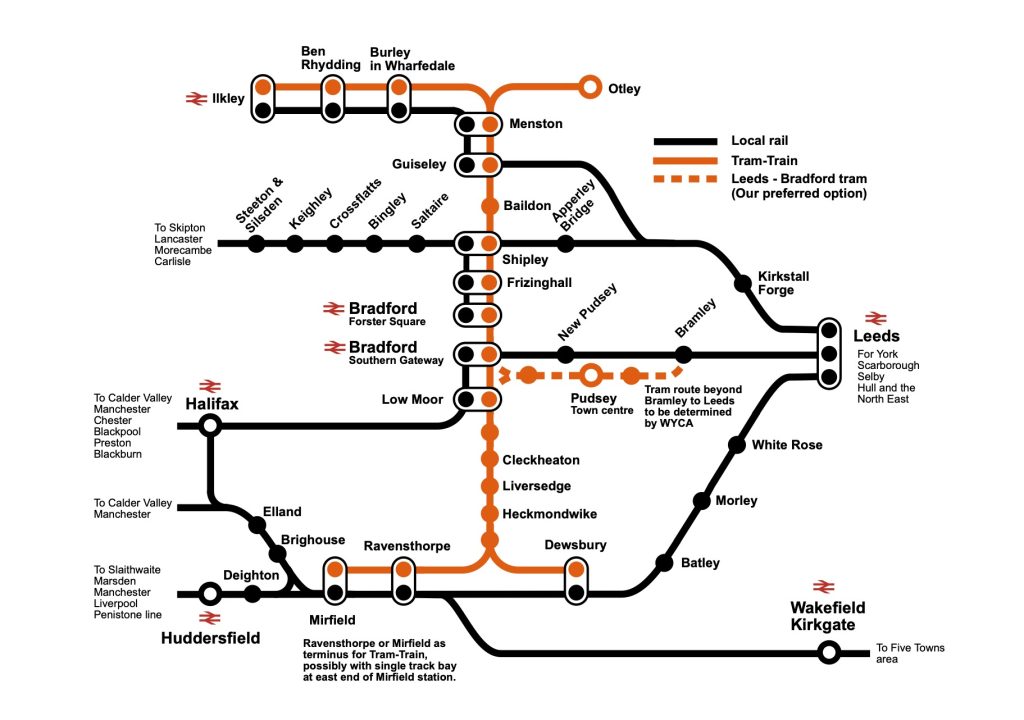
Traffic congestion is a huge economic cost. Significant investment is desperately needed in rail-based systems including the new West Yorkshire Mass Transit system which is hopelessly overdue. But this is still a decade or so away. It should be prioritised together with investment in the Region’s rail network. TransPennine electrification is hugely welcome but is at least two decades overdue. The North desperately need investment in both urban and rural transport, raising standards to those in other Continental European countries notable Switzerland, Germany, much of France, The Netherlands and Austria.
But in the meantime the first priority is to enhance and restore bus service to frequency levels of two decades ago, again restoring cross-boundary services to meet work, leisure and education travel needs not artificial political jurisdictions.
There are lots of effective ways of surveying and measuring the social and economic benefit of new transport services and networks, and Yorkshire has several Universities capable of such work. However, inevitably these benefits will not be instantaneous and will need a three year period to build up as users gain confidence and accept lifestyle changes to enable them to use the new services and realise the many new opportunities, such as access to jobs and education, that may now be available to them.
How should the cost of interventions needed to deliver transport integration be assessed and appraised? Will proposed changes to methodology in the Treasury’s ‘Green Book’, including the introduction of ‘place-based business cases’, change this?
The Treasury’s measurement of cost benefit to justify investment using London-scale criteria has been a disaster and has frozen rail investment in the North for decades – even such quick and huge cross-Regional winner as the reopening of the Skipton-Colne line which would revitalise the East Lancashire and to come extent the West Yorkshire economy, has been ignored. This would provide overheated Leeds with access to cheaper housing in East Lancashire on journey times of less than an hour from central Leeds to Colne or Nelson as well as access to major centres of higher education for young people from East Lancashire.
There is a need for much more holistic approach in the English Regions to transport investment. More must be done to secure long term commitment on both capital and revenue funding e.g. from developers. Yet in our area the very opposite is happening – huge new housing estates have been approved along one key transport corridor at the very time that the core bus service has been reduced by 33% on weekdays and 50% on Sundays. Timetables which are difficult to understand, vary by a few minutes every hour are subject to random waiting delays for imagined congestion yet suffer from constant cancellation and delay. At the same time all competing bus services have been withdrawn on economic grounds. This appalling situation largely ignored by WYCA for whatever reason, is making bus travel the choice of last resort for people in many parts of West Yorkshire, with predictable long term consequences.
Funds secured from congestion charges and workplace parking levies are a major source of revenue – and need to be seen as such – to support urban transport investment and service revenue support in our conurbations and need to be presented as such.
Will integration in itself deliver other benefits such as wider transport options in more places, and behaviour changes such as mode shift? What other impacts could it have?
Evidence from many countries in Europe e.g. The Netherlands – show that well-integrated, well-market public transport, combined with effective traffic management policies can secure significant modal shift, but wider promotion is also crucial. What is needed are high quality service frequencies (10-15 minute daytime intervals, half hourly evenings ) on urban routes and hourly between market towns on rural routes, feeding to and from key railheads. Such networks will secure huge modal shift and reduce both congestion and pollution both of which impose massive economic penalties on the community and also the NHS. What we have now, a result of outdated “free market” economics, is both appallingly wasteful and destructive. Bus franchising is long overdue but will only work if adequately funded and perceived as part of a wider, responsible green travel choice – linked to extensive walking and cycling routes and options to increase physical and mental health. The massive impact on human health of the car, both in terms of passive lifestyle choices and pollution and accidents, should be used as a measure to support the adequate financing of and continued support for the greener alternatives rather than talk of “subsidy” which is an emotive term. The real “subsidy” is the lack of penalties currently being given to those who inflict on society the massive costs of congestion and pollution.
What is needed to ensure that integration is inclusive and meets the diverse needs of transport users? Will integration necessarily lead to better outcomes for accessibility?
Critically we need continuous and meaningful dialogue between actual bus and train users and both bus and train operators and local authorities. What we have at the moment are bus operators that many people feel are totally out of touch with the realities of their own services, senior managers who it is suggested rarely if ever use their own products and cashed starved local authority senior managers who again would seem to have little actual experience of using or managing buses. This is in stark contrast to what used to happen in the days of the Passenger Transport Executives, many of whose employees were recruited from the actual local bus and rail industries and who had therefore extensive local experience, knowledge and understanding who could soon see through the often lame arguments of failing operators, determined to cut services to the minimum to defend profit margins and thereby share prices.
There needs to be new forums set up with real power to take failing bus managers to task, not just vacuous talk shops, following which nothing actually changes.
A huge contrast however to the failing First Leeds monopoly in West Yorkshire is the volunteer managed Dales & Bowland Community Interest Company who manage the highly successful and fully truly integrated DalesBus network on a shoestring budget. DalesBus is a network of up to 14 weekend bus services that operate from York, Harrogate and the Leeds-Bradford conurbation, plus services from other towns in North Yorkshire and even East Yorkshire and Teesside into the Yorkshire Dales National Park and Nidderdale National Landscape. This small group manage and market the Dalesbus services, working with operators, into the Daes. One of their core principles is working closely each year with bus users to design services that meet actual user needs, in this case weekend leisure users and walkers. Users also provide a regular programme of guided walks from DalesBus services even through winter months. This in turn has built a strong brand loyalty. DalesBus also uses a range of printed timetables, a comprehensive booklet and individual leaflets, up to date bus stop information and has also a strong website and online presence, all achieved on a tiny budget.
This compares with such bureaucracies as the West Yorkshire Combined Authority who use up massive resources in endless consultations, strategy and policy documents, none of which result in more than little if any token service improvement, indeed most often only seem to oversee and confirm continuing service decline.
Will the meaning of integration vary across different kinds of areas and for different kinds of journeys? (such as rural and suburban areas, and inter-city journeys)
In urban areas what is required is frequent “clock face” regular interval journeys ideally a daytime frequency of 15 minutes or less so that users in cities and inner suburbs do not need to consult a timetable as the next bus or tram is no more than 12 minutes or so away. In rural areas on key corridors along main roads between market towns, fast, good quality, comfortable bus services capable of attracting drivers out of their cars, should be at least hourly, preferable half hourly between larger centres, but with feeder services which could be by shared taxi or community minibus, feeding into the core network from outlying settlements. Devising such networks is not rocket science. But it does need an imaginative, integrated approach, and be customer led, not forced to meet profit targets or London-imposed budgets. There is a strong case for Regional funding of all rural and urban public transport.
Bus networks should also be designed and timetables created to fit in with the National Rail network to and from key local railheads, even if this might result in slightly altered clock-face departures to meet key trains. Again cross-boundary multi-modal tickets (as indeed are already offered on DalesBus from Leeds and Bradford via Skipton and Ilkley on Northern Rail and onward by DalesBus), are needed.
Why can a small volunteer team in Yorkshire do this when large public authorities such as WYCA, and North Yorkshire fail?
What lessons can be drawn from attempts to integrate transport elsewhere in the UK and around the world? What examples should the Government seek to emulate?
We have already given DalesBus as an example and proof that even in the UK, an integrated and even intermodal public transport network, with a stronger user focus, can be established that will attract passenger usage in significant numbers. But for this to happen on a larger scale we need a change of culture. The appalling and damaging 1985 Transport Act needs to be replaced with something more relevant for the 21st century with an emphasis on cooperation not competition. It must put the needs of passengers – who are not the same things as customers – first, not the needs of shareholders of international corporations.
However, several northern European countries offer evidence of how a genuinely integrated travel network in both urban and rural settings can be made to work, but it has to be centred on community needs not company profits or forced to meet local authority Treasury imposed budgets.
Greater London has proved very much better in achieving these goals than the North of England but that also reflects the fact that Greater London has a single Mayor with executive powers, an elected Assembly and the vision to think beyond local authority boundaries. Devolution of powers in the case of Yorkshire as a great Region not just to four potentially competing Mayors, but through a one strategic body is essential. A single Transport for Yorkshire with powers over bus, rail and LRT networks is perhaps the only way to develop the vision and create the human and financial resources needed to make a difference to the travel opportunities of the Region, especially for a younger generation not yet wedded to a car dependent lifestyle.
What we have now is NOT integration. Public transport in our Region is expensive, unreliable and has disintegrated in more than one sense. Services operate in isolation and rarely if ever meet. Indeed provision has significantly worsened over the last decade. A revolution in thinking is required to secure equality with many of our European neighbours, but even more important allow the Region to grow economically without the massive costs of congestion and pollution and in rural areas, rural isolation and transport poverty caused by poor, inadequate and grotesquely underfunded public transport.